In a nutshell
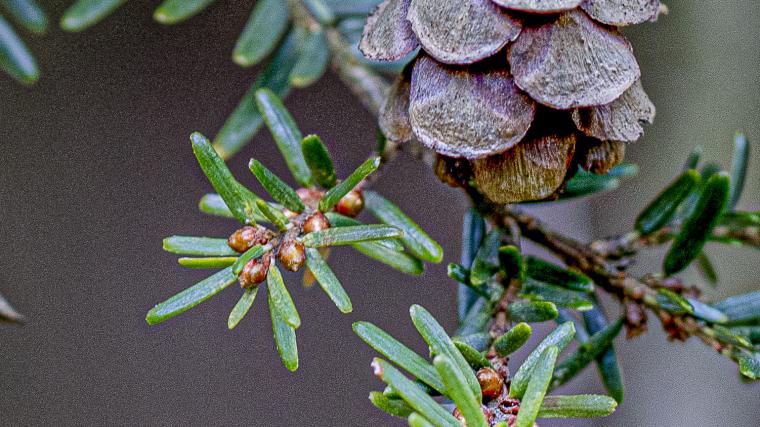
Many forests in North America are threatened by insect pests. In the northeastern U.S. and eastern Canada, outbreaks of spruce budworm occur rarely, but can last 4-6 years and devastate conifer forests. Budworms feed on new foliage of fir and spruce trees, limiting growth and even killing some individuals. Spruce budworms may also feed on eastern hemlock, an evergreen tree in the pine family, but the extent of the potential damage is less understood. Eastern hemlock trees play an important role in Maine forests and are also harvested commercially.
A team of researchers used a novel approach to determine whether spruce budworms pose a threat to eastern hemlock trees. First, they used observations in Nature’s Notebook to show that new buds appear on eastern hemlock trees around the same time that they appear on other host trees. This overlap in budburst timing means that hemlocks could provide food for budworms during outbreaks. Next, they used tree ring data from multiple locations in Maine to understand historical budworm outbreaks. During outbreak years, tree rings in spruce trees were much smaller than rings in normal years, indicating that budworms limited tree growth. When they looked at tree rings from eastern hemlock trees at the same sites, they saw similar patterns during outbreak years. This provided strong evidence that budworms can feed on multiple tree species and not only spruce and fir trees in the eastern U.S. and Canada.
Using this approach, researchers confirmed that eastern hemlocks can be negatively impacted by spruce budworms in addition to other known pests like spongy moth and Hemlock woolly adelgid. This information is especially important now, with a current budworm outbreak in eastern Canada that is expanding into Maine.
What is special about this study?
The authors used data from Nature’s Notebook to show that budburst in eastern hemlock trees occurs at the same time as budburst in fir and spruce trees in eastern forests, making them vulnerable to attacks from spruce budworm. They combined this information with tree ring data to document the extent of damage to forests during budworm outbreaks. This creative approach provides valuable information about potential risks to eastern hemlock, which are important trees for Maine’s forests and economy.
What does this mean for YOU?
The authors would not have been able to establish this link between eastern hemlock and spruce budworm without Nature’s Notebook observations of budburst in eastern trees. The data that Nature’s Notebook observers collect on trees and on pest species can provide land managers with critical information about what trees are at the greatest risk and where and when treatments should be applied.
Citation: Poppe, R., S. Birch, C.H. Guiterman, L.S. Kenefic, E.R. Larson, D.A. Orwig, N. Pederson, and S. Fraver. 2025. Eastern hemlock (Tsuga cadadensis) as an alternate host for spruce budworm (Choristoneura fumiferana): dendrochronological evidence from Maine, USA. Canadian Journal of Forest Research 55: 1-9. https://cdnsciencepub.com/doi/10.1139/cjfr-2025-0161