Teaming up with Thoreau, Smithsonian Magazine, Oct. 2007
Climate Reference Network (CRN) Newsletter, NCDC NOAA, Sept. 2007
Buzzing about Climate Change, Earth Observatory NASA, Sept. 2007
Project Budburst, Become a citizen scientist as you watch flowers bloom
Land Surface Phenology workshop
at US-IALE meeting,
8 April 2008
ASPRS and USA-NPN
Towards a Southwest Phenology Network, Southwest US Region
Oct. 5, 2007
Tucson, AZ
American Geophysical Union
B17: Observing, Analyzing, and Modeling Phenologies at Multiple Scales
Fall Meeting, Dec. 10-14, 2007
San Francisco, CA
Phenology is the study of periodic plant and animal life cycle events and how these are influenced by seasonal and interannual variations in climate. Examples include the timing of leafing and flowering, agricultural crop stages, insect emergence, and animal migration. All of these events are sensitive measures of climatic variation and change, are relatively simple to record and understand, and are vital to both the scientific and public interest.
Phenology can be used as a predictor for a variety of processes and variables of importance at local to global scales. Phenology modulates the abundance and diversity of organisms, their inter-specific interactions, their ecological functions, and their effects on fluxes in water, energy, and chemical elements at various scales. Phenological data and models are useful in agriculture, drought monitoring, and wildfire risk assessment, as well as management of invasive species, pests, and infectious diseases. Integration of spatially-extensive phenological data and models with both short and long-term climatic forecasts offer a powerful agent for human adaptation to ongoing and future climate change. To fully utilize the value in phenological data, however, a new data resource is required – a large-scale network of integrated phenological observations, linked with other relevant data sources, and the tools to analyze these data at multiple scales.
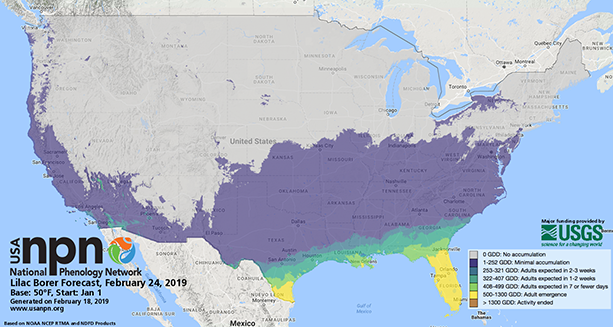
A USA National Phenology Network (USA-NPN) is currently being designed and organized to engage federal agencies, environmental networks and field stations, educational institutions, and mass participation by citizen scientists. The initial phase in Spring 2007 will establish a continental-scale network focused on phenological observations of a few regionally appropriate native plant species and nationally-cultivated indicator plants (e.g., lilacs).